Winter Gas Readiness: Closing the Gap Between Forecast and Daily Execution
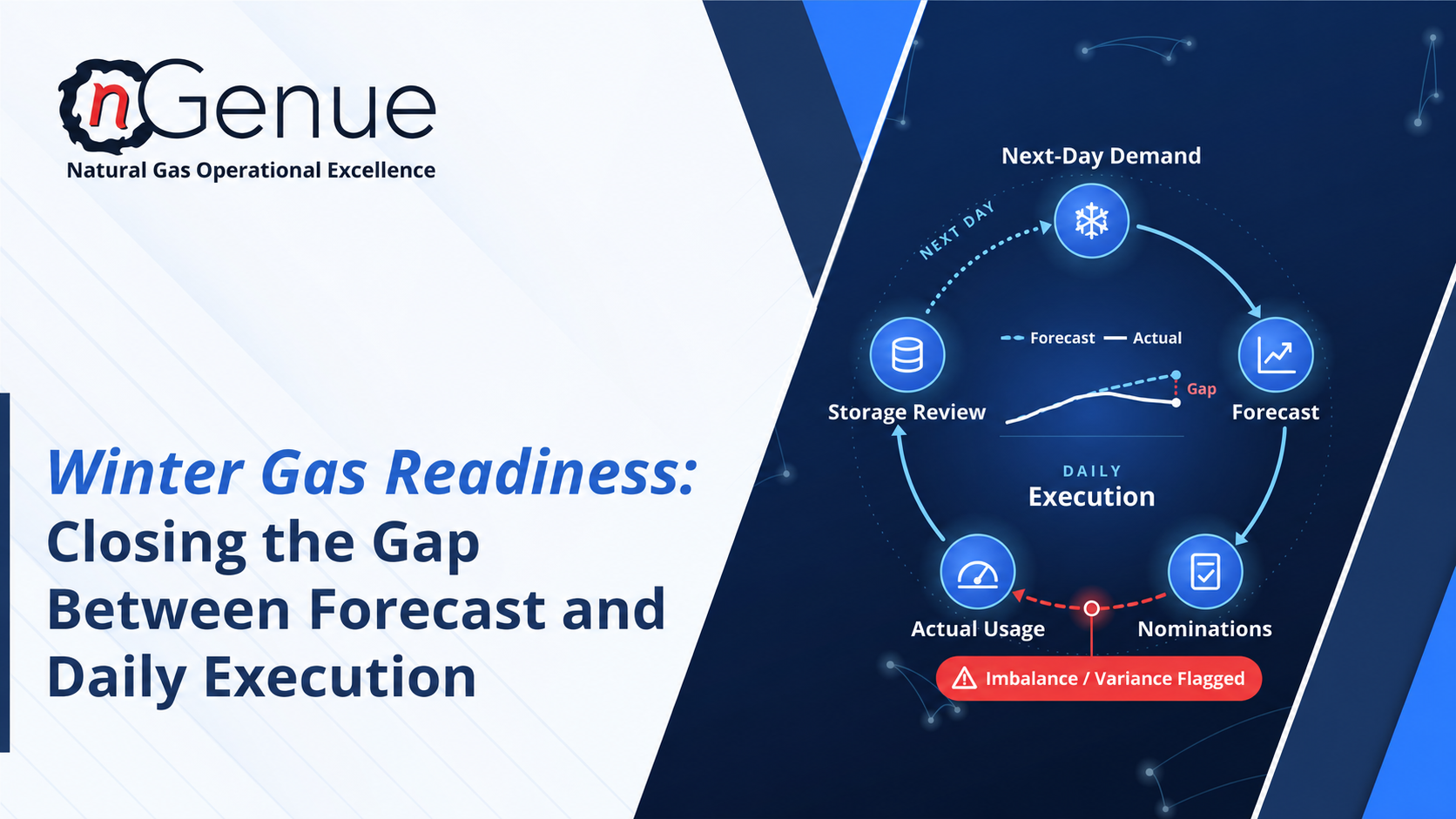
Winter natural gas operations have a way of exposing the difference between having a plan and being ready to execute it.
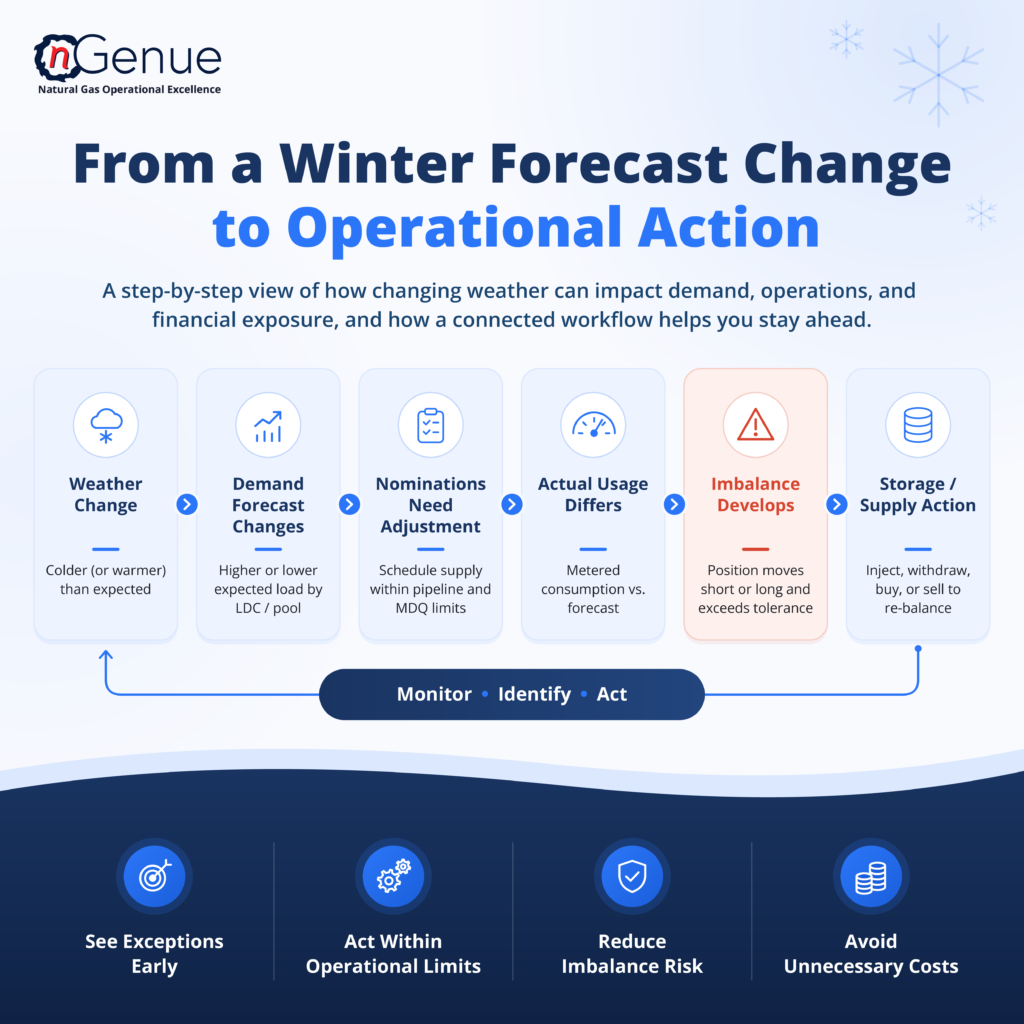
A colder forecast comes in. Expected demand increases. Supply requirements change. Schedulers review nominations and transportation. Actual usage begins moving differently than expected. Storage may need to cover part of the difference.
And all of it may need to happen within the constraints of multiple LDC pools, pipeline capacity, Maximum Daily Quantities, contractual priorities, balancing rules, storage limits, and nomination cycles.
None of these decisions happens independently.
That is why winter readiness is not simply about having enough natural gas available. It is about how quickly a team can understand a changing position and translate it into the right operational decisions.
U.S. natural gas inventories are expected to enter the 2026-27 heating season above the recent five-year average. In its October 6 Short-Term Energy Outlook, the U.S. Energy Information Administration forecast approximately 3,850 Bcf of working natural gas in storage at the end of October, about 2% above the five-year average.
That provides useful market context and an important national cushion.
But a national storage number cannot tell an individual marketer, utility, producer, or end user whether tomorrow’s forecast, supply, nominations, transportation, actual usage, and storage position are aligned.
That work still has to happen every day.
When the Forecast Changes, the Position Changes
Consider a familiar winter operating scenario.
Weather forecasts turn colder and expected demand increases across several customer groups or LDC pools.
The original forecast may have been completely reasonable when it was prepared. The problem is that the operating position has now changed.
Supply teams need to determine how much additional gas may be required. Schedulers need to understand what has already been purchased and nominated, which transportation paths are available, how much capacity remains, whether MDQ limits or contractual priorities apply, and whether storage should become part of the response.
For businesses managing retail demand behind the city gate, the picture can become even more complex.
Customer requirements may span multiple LDCs, pools, pipelines, delivery points, and contractual arrangements. Daily meter information may further change expected load after nominations have already been submitted.
The issue is not simply whether enough gas exists.
The operating team needs to understand:
-
How much expected demand has changed
-
Which LDC pools, customers, or city gates are driving the change
-
What supply has already been committed
-
What volumes have already been nominated
-
Which transportation paths and capacity remain available
-
How much MDQ has already been used
-
What storage inventory and withdrawal capability remain
-
Which balancing or critical-day restrictions apply
-
Which exception requires attention before the next nomination cycle
This is the point where a forecast becomes an operating position.
A revised forecast may indicate that additional gas is needed tomorrow. But the scheduler still has to determine whether that gas can be purchased, transported, nominated, and delivered to the correct location within the applicable rules.
Forecasting demand is one job.
Executing against that demand is another.
The Plan Has to Be Tested Against Actual Usage
Once the gas day begins, the forecast is no longer the only number that matters.
Actual usage begins telling the team whether the operating plan is holding.
Natural gas customers rarely consume exactly what was forecast, particularly when temperatures are changing quickly. Commercial and industrial demand can move unexpectedly. Residential load can react rapidly to weather. Meter reads may arrive throughout the operating cycle.
A position that appeared balanced earlier in the day can therefore look very different a few hours later.
Schedulers and supply teams need to continually understand the relationship between:
Forecast demand → nominated supply → actual usage → resulting balance
If actual usage moves above the nominated position, additional supply or nomination changes may be required.
If usage falls below forecast, the business may become long gas.
If the variance sits within an LDC pool with specific banking, balancing, MDQ, or storage rules, a favorable position somewhere else may not solve the problem.
This is how relatively small daily differences can become meaningful imbalance exposure.
One of our earlier articles on imbalance management described a natural gas supplier managing approximately 1,500 commercial customers. A spreadsheet forecasting error caused part of the portfolio to continue using outdated weather assumptions.
The resulting storage position materially exceeded the team’s planned 90% target.
Warmer weather compounded the problem. Gas continued to be injected while the LDC reduced nominations, and limits on how quickly gas could later be withdrawn made the situation harder to correct.
The result was a series of imbalance and storage penalties approaching half a million dollars.
The lesson was not simply that a spreadsheet error occurred.
People make mistakes. Forecasts change. Weather changes.
The greater risk comes when forecasts, nominations, actual usage, storage balances, and operating limits are not reviewed together early enough to expose the exception.
A strong winter operating process should not depend on someone discovering the problem at month-end.
It should make a developing imbalance visible while the team still has options to correct it.
Storage Is Flexibility, Not Unlimited Capacity
Storage can be one of the most valuable tools available to a natural gas operation during winter.
A well-planned storage position can provide supply when demand moves above expectations, absorb gas when usage falls below plan, reduce dependence on the spot market during severe weather, and provide flexibility when market conditions change.
That is why storage strategy matters before the first major cold event arrives.
But storage should not be confused with unlimited flexibility.
Knowing that gas is physically in storage tells only part of the story.
Teams also need to understand:
-
Current storage balance
-
Injection and withdrawal activity
-
Contractual injection and withdrawal limits
-
Available transportation to and from storage
-
Daily and cumulative contract limits
-
LDC or pipeline restrictions
-
The effect of storage activity on the overall imbalance position
-
Whether changing market conditions favor buying, selling, injecting, or withdrawing
During a cold event, withdrawals can accelerate much faster than originally planned.
During unexpected warm weather, inventories can remain higher than expected and injection flexibility can disappear.
Critical-day conditions can add another layer of operating restrictions when LDCs or pipelines are managing high demand, capacity constraints, or system integrity.
Storage therefore cannot be managed as a separate monthly number.
It has to remain connected to the daily supply and scheduling position.
The most useful view is not simply how much gas is in storage.
It is how storage fits with forecast demand, actual usage, nominations, transportation availability, MDQ exposure, balancing requirements, and the rest of the supply portfolio.
Winter Readiness Is Really Exception Management
No forecast will be perfect.
That should not be the goal.
The goal is to recognize when actual conditions have moved far enough away from the plan that someone needs to act.
A material change in forecast demand should trigger a supply and scheduling review.
A nomination that no longer supports the expected position should be evaluated before the next available cycle.
Actual usage moving outside an acceptable tolerance should trigger an imbalance review.
Storage approaching an injection, withdrawal, inventory, or contractual limit should become visible before the limit creates an operational problem.
MDQ consumption should be understood before additional nominations are placed.
A critical-day restriction should immediately become part of the operating decision.
And repeated imbalance exposure should not remain isolated within scheduling if it is beginning to affect cashout, settlement, accounting, or commercial risk.
This is where connected natural gas operations matter.
nGenue’s supply management workflows are designed to align retail demand with available supply contracts, transportation paths, and LDC pool requirements.
LDC pool forecasts can support supply planning and nomination preparation using historical consumption and weather-adjusted demand assumptions.
Daily pool management can bring together member usage, balancing services, banking limits, MDQ exposure, storage impact, and demand forecasts so schedulers and pool managers can understand the daily operating position.
Daily nominations can then be evaluated against LDC requirements and contractual MDQs.
As actual usage becomes available, nominations, usage, and storage balances can be reviewed together. Developing imbalances can be identified and corrected before they accumulate into larger operational or financial issues.
Storage activity can also be evaluated against contract limits so an injection or withdrawal decision does not create another problem while solving the first one.
That is a very different operating model from managing forecasts in one spreadsheet, nominations in another system, storage somewhere else, and relying on people to manually connect the information.
The technology does not replace the judgment of an experienced scheduler, supply manager, trader, or risk professional.
It gives those people a clearer operating position from which to make the decision.
From Winter Planning to Winter Execution
EIA’s current outlook suggests the United States enters the heating season with relatively healthy natural gas inventories.
That is valuable market context.
Storage provides a buffer against periods of higher consumption or reduced production, but prolonged cold can still increase withdrawals and tighten regional conditions.
Every natural gas business also operates within its own set of customers, supply contracts, pipeline capacity, LDC pools, nomination cycles, storage rights, MDQs, balancing rules, and commercial commitments.
Those operating details determine what a winter event actually means to the business.
Winter readiness therefore cannot be a forecast prepared before the heating season and reviewed occasionally.
It is a daily operating discipline.
The strongest natural gas teams will be the ones that can see when conditions have changed, understand what that change means across supply, nominations, transportation, usage and storage, identify the exception that requires attention, and act while corrective options are still available.
That is the gap between planning for winter and being ready to operate through it.
Talk to the nGenue Team
Our specialists help natural gas teams improve forecasting, scheduling, nominations, and commercial operations.
- Guided walkthrough of nGenue
- Answers tailored to your workflows
- Learn best practices from experts